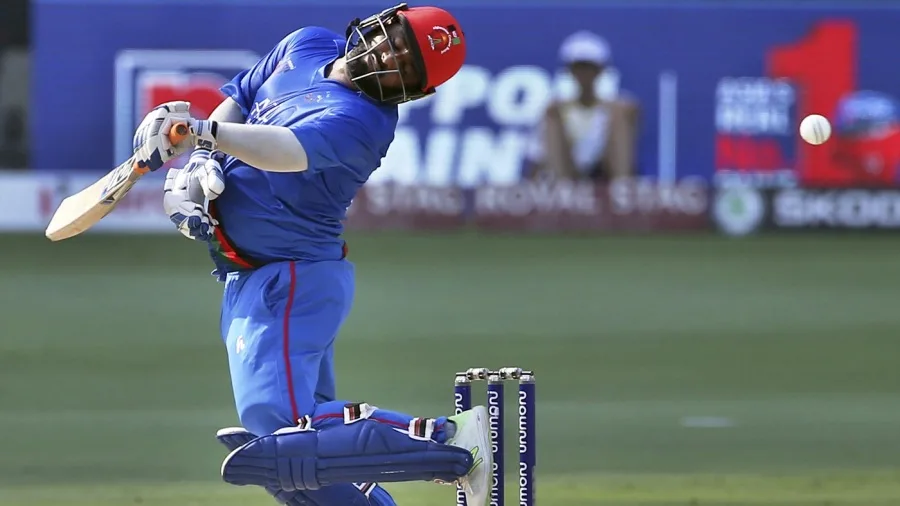
A fast cricket ball travelling directly towards a batter without landing can create a dangerous situation. This delivery is known as a beamer in cricket. It can surprise the batter, leave very little reaction time and potentially cause serious injuries.
Beamers are not always intentional. A bowler may lose control while attempting a yorker, slip during the delivery stride or release the ball incorrectly. However, cricket rules treat these deliveries seriously because of the risk they can pose to the batter.
Under the MCC Laws of Cricket 2026, a non-landing delivery that passes or would pass above waist height is considered unfair and must be called a no-ball. The umpire must separately decide whether the delivery is dangerous because that judgement determines whether the bowler receives a warning or is suspended from bowling.
This guide explains the beamer rule, no-ball penalty, bowler suspension procedure, difference between a beamer and a bouncer, and famous beamer incidents in cricket.
What Is a Beamer in Cricket?
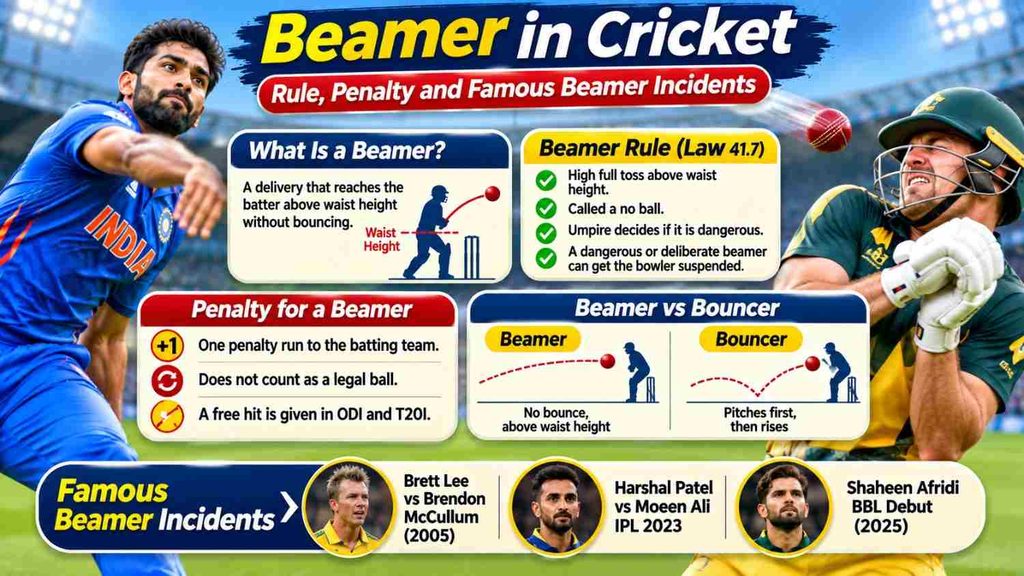
A beamer in cricket is a delivery that reaches or would have reached the batter above waist height without landing.
It is also commonly called a high full toss. Unlike a normal full toss, which may reach the batter below waist height, a beamer travels directly towards the batter without landing and passes above the defined waist-height level.
Under the MCC Laws of Cricket 2026, this delivery is covered by Law 41.7: Bowling of dangerous and unfair non-landing deliveries.
The delivery is considered unfair regardless of whether the bowler intended to bowl it. Therefore, even an accidental beamer must be called a no-ball.
Beamers are usually associated with fast bowlers, but spin bowlers and medium-pace bowlers can also bowl them.
Beamer Rules in Cricket: What Does Law 41.7 Say?
MCC Law 41.7 explains how umpires deal with high full tosses that reach the batter without landing.
There are two separate decisions:
- Is it an unfair non-landing delivery? If the ball passes or would pass above waist height, it must be called a no-ball.
- Is it dangerous? The umpire separately considers whether the delivery creates a risk of injury to the batter.
The second decision is important because not every beamer automatically results in a warning or suspension.
Why Did the Law Change in April 2019?
The distinction between an unfair delivery and a dangerous delivery exists because of an important amendment to MCC Law 41.7, which came into effect on 1 April 2019.
Under the original 2017 Code, every above-waist non-landing delivery was treated as both dangerous and unfair. This meant that bowlers could face severe consequences even when a full toss passed harmlessly away from the batter.
MCC received feedback that these sanctions were overly severe, particularly for younger bowlers. It therefore amended Law 41.7 to give umpires more discretion when deciding whether a delivery was dangerous.
Under the amended law, an above-waist non-landing delivery remains unfair and must be called a no-ball. However, the umpire must make a separate judgement about whether it is dangerous before starting the first-and-final warning procedure.
This 2019 amendment created the two-stage test that applies under the current law.
How Is Waist Height Judged?
The umpire judges the delivery against the waist height of a batter standing upright at the popping crease.
Under the MCC definition, waist height is the point where the top of the batter’s trousers would conventionally be when standing upright at the popping crease.
The batter’s actual movement does not change this reference position. For example, if a batter crouches, moves forward or changes their stance, the umpire still considers where the ball would have passed relative to an upright batter at the popping crease.
How Does the Umpire Decide Whether a Beamer Is Dangerous?
Under MCC Law 41.7.2, a non-landing delivery is also dangerous if the bowler’s-end umpire considers that there is a risk of injury to the batter.
When making this judgement, the umpire must disregard the batter’s protective equipment and consider:
- The speed, height and direction of the delivery.
- The skill of the batter.
- The repeated nature of such deliveries.
The umpire must make an assessment of the risk of injury rather than automatically treating every above-waist full toss as dangerous.
This means a delivery can be called a no-ball because it passes above waist height without necessarily being judged dangerous.
Are Beamer and Bouncer Warnings Independent?
Yes. Under MCC Law 41.6.5 and Law 41.7.5, the warning and action sequences for dangerous short-pitched deliveries and dangerous non-landing deliveries are independent.
A warning for dangerous short-pitched bowling does not count as a warning for a beamer, and a beamer warning does not count towards the short-pitched delivery sequence.
MCC Law and ICC Playing Conditions
MCC Law 41.7.2 describes a dangerous non-landing delivery in terms of a risk of injury to the batter.
Some ICC playing conditions use a more specific formulation, referring to a delivery considered likely to inflict physical injury on the batter, including by its speed and direction. Therefore, readers should distinguish between the MCC Laws and the playing conditions applicable to a particular international competition.
What Is the Penalty for a Beamer in Cricket?
A beamer is called a no-ball. The batting team receives one penalty run immediately.
The delivery does not count as one of the valid balls in the over. Any additional runs scored from the delivery are added according to the normal scoring laws.
| Consequence | Rule |
| Umpire decision | No-ball |
| Penalty | 1 run to the batting team |
| Counts in the over | No |
| Free hit | Applies under standard ICC ODI and T20I playing conditions |
| Bowler’s figures | No-ball is charged to the bowler |
| Further action | Depends on whether the delivery is judged dangerous or deliberately unfair |
In standard ICC ODI and T20 international cricket, a no-ball also results in a free hit on the next delivery under the applicable playing conditions. If that delivery is itself a no-ball or wide, the following delivery remains a free hit.
However, a free hit is not a universal rule across every cricket format. Test cricket does not generally use the free-hit rule, so the applicable competition’s playing conditions must be considered.
Can a Bowler Be Suspended for Bowling Two Dangerous Beamers?
Yes. A bowler can be suspended from bowling after repeated dangerous non-landing deliveries. However, the rule does not simply say that every second beamer results in removal.
Under MCC Law 41.7, the umpire follows this process:
First Dangerous Beamer
If the umpire considers a non-landing delivery dangerous because of the risk of injury to the batter, the bowler receives a first-and-final warning.
The umpire also informs the other umpire, the fielding captain and the batters.
This warning applies when the delivery is judged dangerous, not simply because it is a high full toss.
Further Dangerous Beamer
If the same bowler delivers another dangerous non-landing delivery during that innings after receiving the first-and-final warning, the umpire calls a no-ball and instructs the fielding captain to suspend the bowler from bowling for the rest of the innings.
Another eligible bowler must complete the over if required. That replacement bowler cannot have bowled any part of the previous over and cannot bowl any part of the next over.
Deliberately Bowled Unfair Non-Landing Delivery
A deliberately bowled unfair non-landing delivery is treated more seriously.
Under MCC Law 41.7.6, if the umpire decides that the bowler deliberately bowled an unfair non-landing delivery, the first-and-final warning procedure is skipped. The bowler is immediately suspended from bowling for the remainder of the innings.
This is an important distinction: an accidental beamer that is not judged dangerous still receives a no-ball, but does not automatically trigger the dangerous-bowling warning sequence.
Difference Between a Beamer and a Bouncer
A beamer and a bouncer are different types of deliveries. The main difference is whether the ball lands before reaching the batter.
| Feature | Beamer | Bouncer |
| Landing | Does not land before reaching the batter | Lands before reaching the batter |
| Trajectory | Travels directly towards the batter | Rises after bouncing |
| Height rule | Above waist height without landing | Judged under short-pitched delivery rules |
| Legality | Unfair and called a no-ball | Can be legal within applicable limits |
| Main risk | Very little reaction time against a high full toss | High bounce and potential impact on the batter |
A bouncer is a recognised bowling tactic. A beamer is an unfair non-landing delivery under the Laws of Cricket.
A short-pitched ball is not automatically a beamer simply because it reaches the batter above waist height. Since it has landed before reaching the batter, the relevant short-pitched delivery rules apply.
A bouncer is not automatically illegal. Its legality depends on the applicable height, frequency and competition playing conditions.
Why Do Bowlers Accidentally Bowl Beamers?
Most accidental beamers result from a loss of control during the delivery. Possible contributing factors include:
- Slippery grip: Sweat, rain or moisture can make it difficult to hold the ball securely.
- Incorrect release timing: Releasing the ball too early or too late can change its trajectory.
- Failed yorker attempt: A bowler trying to deliver a yorker may release the ball incorrectly, producing a high full toss.
- Poor balance: Slipping or losing balance during the delivery stride can affect the release point.
- Fatigue and pressure: Tiredness or pressure may affect a bowler’s concentration and control.
Fast bowlers often attempt yorkers at the end of limited-overs innings. A mistake in release timing or balance can turn a yorker attempt into a high full toss.
However, these are possible contributing factors rather than a definitive explanation for every beamer.
Famous Beamer Incidents in Cricket History
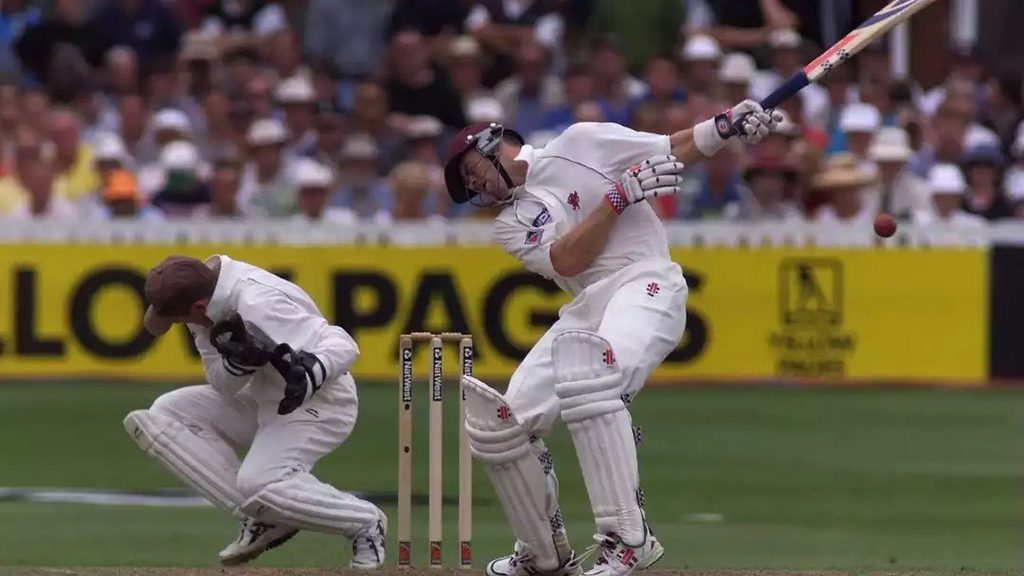
Source Image: Cricbuzz
Beamers have caused controversy in international and domestic cricket. These incidents also demonstrate why the rules distinguish between an unfair delivery and one considered dangerous.
1. Brett Lee and Brendon McCullum, 2005
One widely reported beamer incident involved Australian fast bowler Brett Lee and New Zealand batter Brendon McCullum.
During the third ODI between Australia and New Zealand at Eden Park, Auckland, on 26 February 2005, Lee delivered a high full toss that struck McCullum on the arm.
McCullum reacted angrily, and Lee apologised after the incident.
Lee later explained that heavy dew had affected his footing and caused him to lose control of the delivery. The incident attracted considerable attention, with New Zealand coach John Bracewell publicly expressing concern about repeated beamers.
2. Jhulan Goswami and Nicola Carey, 2021
A notable example of the two-stage beamer rule occurred during the second ODI between India and Australia on 24 September 2021 in Mackay.
In the final over, Indian fast bowler Jhulan Goswami delivered a high full toss that struck Australian batter Nicola Carey on her helmet. The delivery was directed towards Carey’s head, and umpire Claire Polosak gave Goswami a first-and-final warning because it was considered dangerous.
Goswami later bowled another above-waist full toss to Carey. The delivery was reviewed and called a no-ball, but the umpire judged it to be away from the batter’s body and not dangerous.
As a result, Goswami was allowed to continue bowling and deliver the final ball of the match.
This incident clearly demonstrated the two-stage test under Law 41.7. Both deliveries were above-waist no-balls, but only the first was judged dangerous enough to trigger the warning. The second did not result in suspension because it was not considered dangerous.
Australia eventually won the match by two wickets, with Nicola Carey involved in the final runs.
3. Shaheen Afridi’s BBL Debut, 2025
Pakistan fast bowler Shaheen Shah Afridi had a difficult Big Bash League debut for Brisbane Heat against Melbourne Renegades on 15 December 2025.
During the 18th over, Afridi bowled two waist-high full tosses. Both were called no-balls, and the umpires removed him from the attack.
Nathan McSweeney completed the over.
Melbourne Renegades scored 212/5 and defeated Brisbane Heat by 14 runs.
The incident attracted attention because Afridi was one of the most recognised fast bowlers in international cricket, yet even an experienced player can lose control during a match.
How Can Bowlers Avoid Bowling a Beamer?
Bowlers can reduce the risk of beamers by improving their release control and maintaining balance.
- Practise yorkers with a consistent release point.
- Keep the bowling grip secure, especially in wet conditions.
- Maintain balance throughout the delivery stride.
- Avoid rushing the bowling action under pressure.
- Practise variations at a controlled pace before using them in matches.
- Focus on a consistent release position during different match situations.
Fast bowlers should also communicate with umpires if the ball becomes wet or difficult to grip. Good control helps protect both the bowler and the batter.
Conclusion
A beamer in cricket is an unfair high full toss that reaches or would reach the batter above waist height without landing. Under MCC Law 41.7, it must be called a no-ball and gives the batting team one penalty run.
The umpire must separately decide whether the delivery is dangerous. A first dangerous delivery brings a first-and-final warning, another dangerous delivery after that warning can result in suspension for the rest of the innings, and a deliberately bowled unfair non-landing delivery can result in immediate suspension for the remainder of the innings.
Understanding these rules helps cricket fans distinguish between an accidental loss of control, dangerous bowling and a legal bouncer.
Frequently Asked Questions About Beamer in Cricket
A beamer is a non-landing delivery that reaches or would reach the batter above waist height. Under MCC Law 41.7, it is considered unfair and must be called a no-ball.
Yes. Under MCC Law 41.7, a non-landing delivery that passes or would pass above the waist of an upright batter at the popping crease is unfair and must be called a no-ball.
However, not every beamer is automatically judged dangerous. The umpire makes a separate assessment to decide whether the dangerous-bowling warning and suspension procedure applies.
The batting team receives one penalty run for the no-ball. Any additional runs scored from the delivery are added separately under the scoring rules.
A bowler may be suspended after another dangerous delivery following a first-and-final warning. Two high full tosses do not automatically mean suspension. A deliberate unfair non-landing delivery can result in immediate suspension.
A beamer reaches the batter without landing and above waist height. A bouncer lands first and then rises towards the batter. A bouncer can be legal within the applicable short-pitched delivery limits.